

Why Do I Shut Down Emotionally When Things Get Too Much?

Have you ever been in the middle of a difficult conversation and suddenly found yourself with nothing to say?
Maybe someone asks what's wrong, but you can't explain it. You know something is bothering you, yet finding the words feels impossible. You might go quiet, withdraw from people, or feel completely disconnected from what is happening around you.
Sometimes, you might not even feel upset anymore. You just feel nothing.
This experience is often described as emotional shutdown. It can happen when stress, difficult emotions or overwhelming situations become too much to process.
For some people, it happens during arguments. For others, it develops gradually after weeks or months of pressure. It can also be connected to past experiences that have influenced how someone responds to stress.
Understanding why this happens is an important starting point. Rather than judging yourself for shutting down, you can begin recognising what your mind and body might be responding to.
What does emotional shutdown feel like?
Emotional shutdown doesn't look the same for everyone.
Some people become unusually quiet. Others continue going about their day, attending work, looking after their family and completing everyday responsibilities, while feeling emotionally disconnected.
You might notice that you:
Struggle to explain what you're thinking or feeling.
Feel emotionally numb, empty or disconnected.
Withdraw from conversations or avoid answering messages.
Find it difficult to make even simple decisions.
Lose interest in activities you would normally enjoy.
Feel exhausted after emotional conversations.
Want to be alone, even when someone is trying to support you.
Feel overwhelmed when people ask you too many questions.
You might also experience physical changes, such as tiredness, muscle tension or difficulty concentrating.
Imagine coming home after a stressful day. Your partner asks how you're feeling, but instead of talking about what's happened, you say, "I'm fine."
You're not necessarily trying to hide anything. You might genuinely struggle to put the experience into words.
The more questions you're asked, the harder it becomes to respond.
What looks like disinterest or avoidance from the outside may actually be someone struggling with emotional overload.
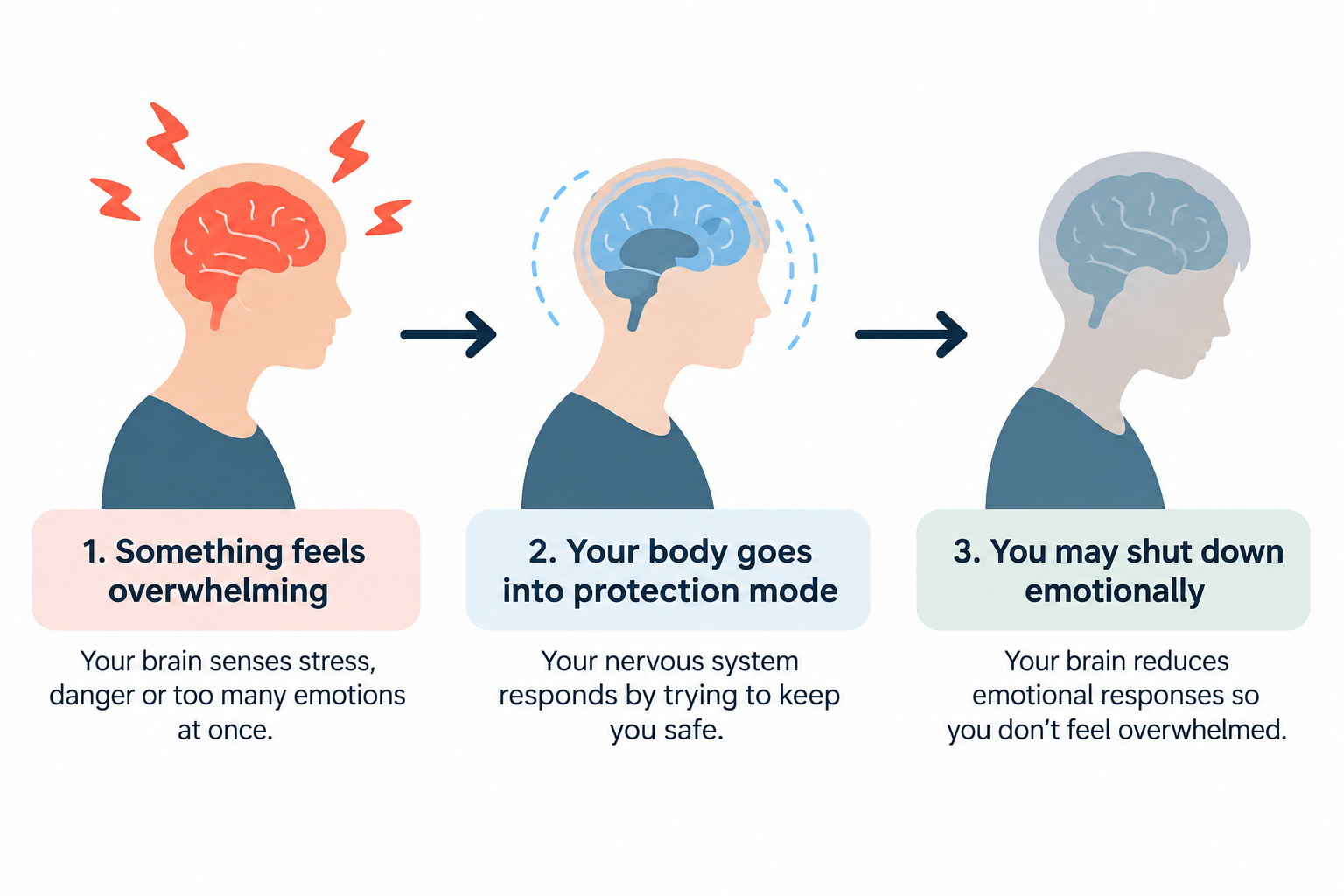
Why do I shut down when I'm overwhelmed?
When we experience stress, our bodies respond in ways designed to help us manage difficult or threatening situations.
You may have heard of the fight, flight or freeze response. These are different ways our nervous system can react when we perceive danger or feel overwhelmed.
Not every stressful situation involves physical danger. Conflict, criticism, uncertainty, relationship difficulties and ongoing responsibilities can also create strong emotional responses.
For some people, stress is expressed through anxiety, restlessness or irritability.
For others, the response may involve becoming quieter, less responsive or emotionally disconnected.
Emotional shutdown can sometimes be understood as a protective response. When feelings become difficult to manage, a person may experience a reduction in emotional awareness or engagement.
However, emotional shutdown is a description of an experience, not a medical diagnosis. It can have several contributing factors, including chronic stress, exhaustion, depression, trauma-related difficulties or other health concerns.
If you'd like to understand more about how our bodies respond to stress, read my article on fight, flight and freeze responses.
Can past experiences cause emotional shutdown?
Sometimes, the way we respond to difficult situations today is influenced by experiences we've had previously.
Think about someone who grew up in an environment where expressing emotions regularly led to arguments, criticism or rejection.
They may have learned that staying quiet was the safest way to handle conflict.
As an adult, they might find themselves withdrawing whenever someone raises their voice, even when the current situation is different from what they experienced growing up.
Someone who has experienced a difficult relationship, serious illness, injury or other distressing event may also notice changes in how they respond emotionally.
These patterns aren't always conscious decisions.
A person might understand that someone is trying to help them but still find it difficult to open up.
This doesn't mean every experience of emotional shutdown is caused by trauma. Stress, fatigue, relationship patterns and mental health difficulties can also contribute.
What matters is recognising whether your reactions are affecting your wellbeing or preventing you from responding to situations in the way you'd like.
You can read more about how past experiences can affect your life even years later.
Why do I push people away when I'm struggling?
One of the most difficult parts of emotional shutdown is how it can affect relationships.
You might care deeply about someone but struggle to communicate when you're upset.
Perhaps your partner wants to talk about a disagreement, but you need space. They interpret your silence as rejection, become frustrated and ask more questions.
The more pressure you feel to respond, the more overwhelmed you become.
Eventually, both people feel unheard.
This can create a frustrating cycle:
Something stressful or upsetting happens.
You begin feeling overwhelmed.
You withdraw or become quiet.
The other person feels rejected or confused.
They push for an explanation.
You become even less able to communicate.
Over time, this pattern can affect trust and emotional connection.
It can help to recognise that needing space and avoiding a conversation indefinitely are two different things.
Taking a break when you're overwhelmed may help you return to the discussion more calmly.
For example, you could say:
"I'm finding it hard to talk about this right now. I do want to sort it out, but I need some time before we continue."
This gives the other person some reassurance while allowing you time to manage what you're experiencing.
Of course, not every relationship feels emotionally safe. If withdrawing is connected to intimidation, controlling behaviour or fear of another person's reaction, the focus should be on your safety rather than forcing yourself to communicate.
What can I do when I notice myself shutting down?
You don't need to force yourself to explain everything immediately.
Sometimes, the first step is simply recognising what's happening.
The following strategies may help you manage emotional overwhelm and become more aware of your responses.
Notice your early warning signs
Emotional shutdown doesn't always happen suddenly.
You might notice that your concentration begins to slip, your body becomes tense or you stop wanting to participate in a conversation.
Perhaps you start giving shorter answers, feel mentally exhausted or become unusually irritated.
Try asking yourself:
What was happening just before I started feeling disconnected?
Was I feeling criticised, pressured, frightened or overwhelmed?
Have I been dealing with more stress than usual?
Does this happen in particular situations or relationships?
You don't need to have all the answers.
Recognising patterns can help you understand when you may need additional support, rest or a different way of responding.
Bring your attention back to the present
When you're feeling disconnected, a grounding exercise may help you reconnect with your surroundings.
You could try:
Looking around and identifying five things you can see.
Noticing the feeling of your body against the chair or another supporting surface.
Listening for three different sounds around you.
Holding an object and paying attention to its texture or temperature.
Taking a few slow, comfortable breaths without forcing them.
Grounding isn't about making unwanted emotions disappear. It's about helping you become more aware of the present moment.
Different techniques work for different people. If an exercise makes you feel more uncomfortable, it's okay to stop and try something else.
Give yourself permission to take a break
When you're already overwhelmed, trying to solve every problem immediately can make things harder.
Sometimes, taking a short break allows you to gather your thoughts.
You could move somewhere quieter, have a drink of water, listen to music or spend some time doing an activity you find calming.
If you're taking a break during a disagreement, consider letting the other person know when you'll return to the conversation.
The goal isn't to avoid difficult emotions forever. It's to approach them when you're in a better position to respond.
Start by identifying one feeling
You don't need to understand every emotion you're experiencing.
Start with something simple.
Ask yourself:
"If I had to describe how I'm feeling in one word, what would it be?"
Maybe it's frustrated, disappointed, anxious, exhausted or uncertain.
If you can't identify an emotion, notice what you can describe.
Perhaps your shoulders feel tight, you're struggling to concentrate or you just want everything to stop for a while.
You could write down a few thoughts or record a private voice note.
Over time, recognising these smaller signals may make it easier to understand and communicate your needs.
Look at what's contributing to your stress
Sometimes, emotional shutdown is less about one upsetting event and more about everything that has been building up.
Work pressures, financial problems, caring responsibilities, relationship difficulties and health concerns can gradually reduce your capacity to cope.
Ask yourself whether there are responsibilities you could share, boundaries you need to establish or situations where you're expecting too much of yourself.
You may not be able to change everything that's happening, but identifying one manageable adjustment can be a useful place to begin.
Is emotional shutdown the same as depression?
Not necessarily.
Emotional shutdown can describe a temporary response to stress, while depression is a mental health condition that can affect mood, motivation, thinking, sleep and daily functioning.
However, there can be some overlap.
Persistent emotional numbness, withdrawal from others or losing interest in activities you previously enjoyed can sometimes be associated with depression.
Other factors, including medication effects and physical health conditions, may also contribute to feeling emotionally flat or disconnected.
If these experiences are ongoing, worsening or interfering with your daily life, consider speaking with your GP or an appropriately qualified mental health professional.
You don't need to work out the cause by yourself before seeking support.
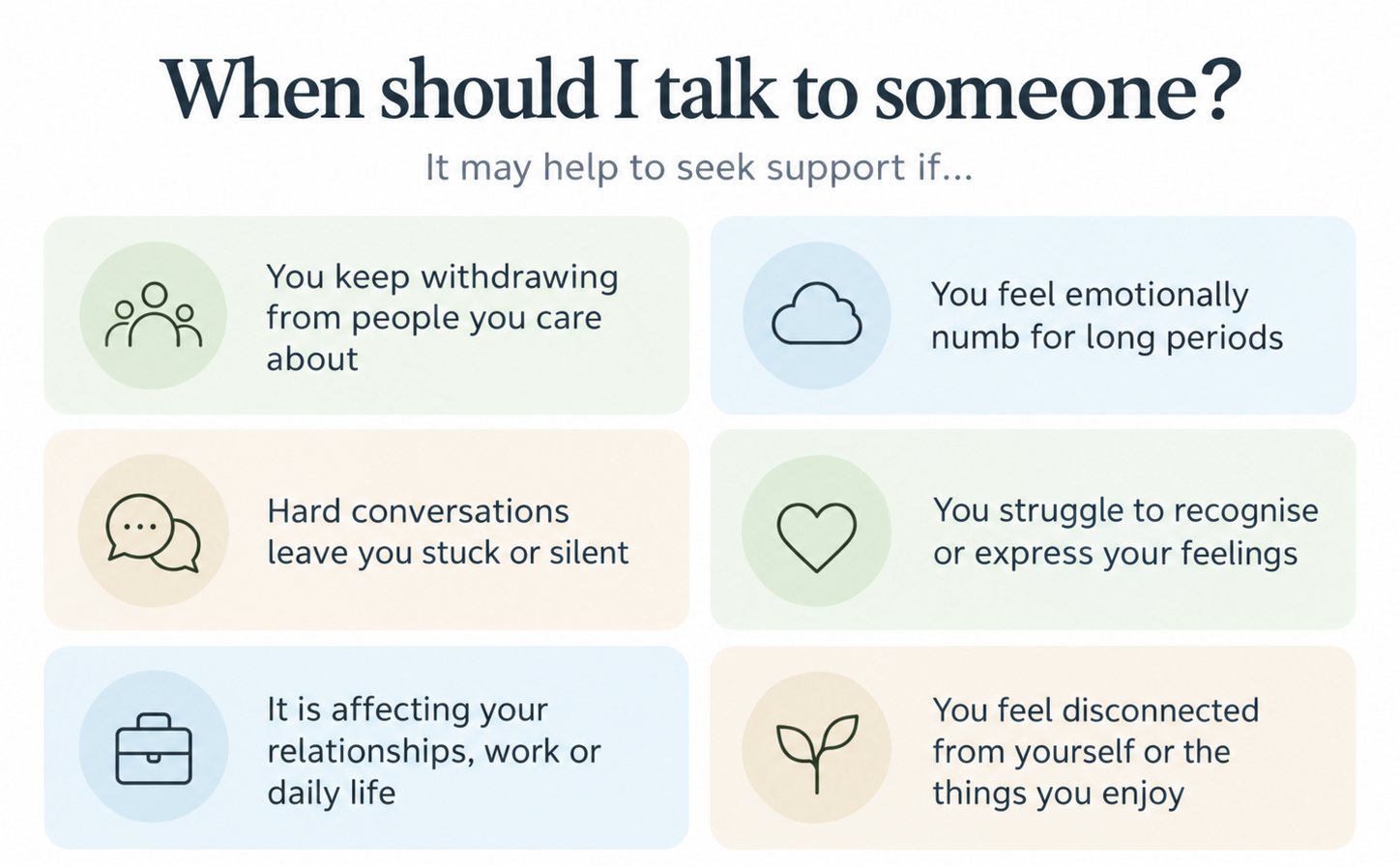
When should I consider talking to someone?
Everyone experiences difficult emotions differently, and occasionally needing time or space doesn't automatically mean something is wrong.
However, it may be worth seeking additional support if:
You regularly withdraw from people you care about.
You feel emotionally numb for long periods.
Difficult conversations repeatedly leave you unable to respond.
You're struggling to recognise or express your feelings.
Your reactions are affecting your relationships, work or everyday life.
You feel disconnected from yourself or the things you usually enjoy.
Counselling can provide a confidential space to explore what's happening without needing to have everything figured out beforehand.
This might involve looking at the situations that trigger overwhelm, understanding patterns that have developed over time and finding practical ways to manage difficult emotions.
It's not about forcing you to talk about experiences you're not ready to discuss.
It's about working at a pace that feels manageable and developing a better understanding of yourself.
You don't have to solve everything at once
If you've been shutting down emotionally, it can be frustrating when other people expect you to explain what's happening.
You might even become frustrated with yourself.
But recognising a pattern is already an opportunity to respond differently.
Maybe that means noticing when you're becoming overwhelmed, asking for a break before a conversation becomes too difficult, or learning how to express what you're feeling in smaller steps.
Progress doesn't necessarily mean never shutting down again.
It might mean recognising the signs earlier, understanding what you need and developing ways to manage situations that previously felt impossible.
And if you've been struggling for a long time, you don't have to work through it alone.
Counselling support in Cairns and online
I'm Allan Bunyan, a counsellor at Strong Foundation Support Counselling.
I work with people experiencing stress, anxiety, difficult life experiences, emotional overwhelm and challenges that can affect their everyday wellbeing.
My approach is practical, collaborative and trauma-informed. We can explore what's happening in your life, identify patterns that may be contributing to your difficulties and work towards changes that are meaningful to you.
I offer face-to-face counselling in Cairns, along with phone, video and live chat counselling.
If emotional shutdown is connected to difficult past experiences, you can learn more about my trauma counselling in Cairns.
If ongoing worry or stress is contributing to how you're feeling, you can also explore my anxiety counselling services.
Ready to have a conversation?
You're welcome to book a free 15-minute introductory phone call to ask questions and see whether counselling might be right for you.
Strong Foundation Support Counselling | Cairns, Queensland
This article provides general mental health information and is not a substitute for individual assessment or healthcare advice.
